
Concrete Grades Explained: M5 to M40 and Their Uses
-
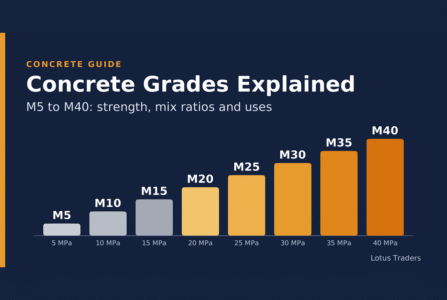
- M5: lean concrete for leveling beds.
-
- M10: plain concrete under footings, footpaths.
-
- M15: plain concrete floors and non-structural work.
-
- M20: standard reinforced concrete (RCC) for low-rise buildings.
-
- M25: RCC columns, beams and slabs in moderate exposure.
-
- M30: heavier loads and tougher weather.
-
- M35: bridges, industrial floors, severe exposure.
-
- M40: high-rise, prestressed and very severe exposure, as specified by the designer.
The short answer: A concrete grade such as M20 tells you the strength the concrete should reach after 28 days. The “M” stands for mix. The number is the compressive strength in MPa (N/mm²), tested on a 150 mm cube. Lower grades (M5 to M15) go under and around structures. Middle grades (M20 to M25) carry most ordinary buildings. Higher grades (M30 to M40) are for heavy loads and harsh conditions.
Pick the wrong one and you either overspend on cement or build something weaker than the drawing asks for. This guide covers the concrete grades from M5 to M40: what the numbers mean, the usual mix ratios, where each grade is used, and how to get the strength on site.
You will also see why a good mixer matters. The grade is only a target. How you batch and mix decides whether you reach it.
What Do M5, M10, M20 and Other Concrete Grades Mean?
The letter M stands for mix. The number is the characteristic compressive strength in megapascals (MPa). One MPa equals one N/mm².
Characteristic strength is the value below which no more than 5 percent of test results are expected to fall. So M20 should reach at least 20 N/mm² at 28 days. That is roughly 200 kg per square centimetre of crushing strength.
The test is simple. A sample is cast into a 150 mm cube, cured, and crushed in a testing machine at 7 and 28 days.
Nominal Mix vs Design Mix
There are two ways to arrive at a grade.
-
- Nominal mix: fixed proportions of cement, sand and aggregate, such as 1:2:4. It suits small, lower-grade jobs.
-
- Design mix: proportions worked out from lab trials using your actual materials. It suits higher grades and larger jobs.
A ratio of 1:2:4 means 1 part cement, 2 parts sand and 4 parts coarse aggregate. The proportions are normally by volume, so how you measure matters.
Concrete Grades at a Glance
| Grade | Strength at 28 days | Typical mix (cement:sand:aggregate) | Common use |
| M5 | 5 MPa | 1:5:10 | Lean concrete, leveling |
| M10 | 10 MPa | 1:3:6 | Plain concrete under footings, footpaths |
| M15 | 15 MPa | 1:2:4 | Plain concrete floors, non-structural work |
| M20 | 20 MPa | 1:1.5:3 | RCC slabs, beams, columns (low-rise) |
| M25 | 25 MPa | 1:1:2 (small jobs) or design mix | RCC in moderate exposure |
| M30 | 30 MPa | Design mix | Heavier loads, tougher exposure |
| M35 | 35 MPa | Design mix | Bridges, industrial floors |
| M40 | 40 MPa | Design mix | High-rise, prestressed, severe exposure |
Treat the nominal ratios as a starting point. Water, sand quality and curing can move the real strength a long way.
M5 and M10 Concrete: Lean Mixes for Base Work
M5 is a lean mix with very little cement. It is not a structural grade. It is poured as a clean, level base so that steel and formwork do not sit on bare soil.
M10 is a step up and a common choice for plain concrete (PCC) under footings and foundations. It also appears in footpaths and similar light work. It carries no reinforcement and is not meant for structural members.
M15 Concrete: Plain Concrete Work
M15 is typically used for plain concrete in non-structural work, such as floor bases and levelling courses. It is also the minimum grade IS 456 sets for plain concrete in mild exposure.
If a drawing says “PCC 1:2:4”, this is the grade people usually mean.
M20 Concrete: The Standard for Everyday RCC
M20 is the workhorse. IS 456 sets M20 as the minimum grade for reinforced concrete in mild exposure. That makes it common for slabs, beams and columns in low-rise homes.
The usual nominal mix is 1:1.5:3. It works well when materials are consistent and batching is controlled. Poor batching is where M20 jobs go wrong.
M25 Concrete: A Step Up for Moderate Exposure
M25 is the next grade up and is common for RCC in moderate exposure and for commercial buildings. It gives a margin over M20 for columns and heavily loaded members.
Some small jobs use a 1:1:2 nominal mix. Most engineers prefer a design mix at this grade because the cement content is high and small errors cost strength.
M30, M35 and M40 Concrete: Design-Mix Grades
From M30 upward, plan a design mix. A lab works out proportions from your sand, aggregate and cement. Weigh batching is the norm, and admixtures are often used.
-
- M30: heavier loads, tougher exposure, water-retaining structures.
-
- M35: bridges, industrial floors, severe exposure.
-
- M40: high-rise columns, prestressed work and very severe or extreme exposure, where the designer specifies it.
Higher grades cost more per cubic metre. Use them where the design needs them, not as a default.
How to Choose the Right Concrete Grade
Your structural engineer picks the grade. IS 456 sets minimum grades by exposure condition.
| Exposure | Minimum grade, RCC | Minimum grade, plain concrete |
| Mild | M20 | M15 |
| Moderate | M25 | M20 |
| Severe | M30 | M20 |
| Very severe | M35 | M20 |
| Extreme | M40 | M25 |
Exposure describes the weather and conditions the concrete will face. A sheltered indoor slab sits at the mild end. A structure exposed to heavy rain, water or aggressive soil sits higher. Confirm the class with your engineer before ordering. You can check the standard itself on the BIS page for IS 456:2000.
Why Mixing Decides Whether You Reach the Grade
The mixer does not change the grade. The mix design does. But the mixer controls how well that design is carried out.
Hand mixing varies from batch to batch. One batch has more water, the next has less cement at the bottom of the pile. A concrete mixer machine gives the same batch size and the same mixing action every time, which keeps results close to the target. A machine will not fix bad materials, though. Dirty sand or too much water will cost you strength with any mixer. If you are comparing concrete mixer machines for your site, ask which batch sizes suit your grade and daily output.
Practical Tips for Hitting Your Grade
-
- Measure by weight or with gauge boxes, not by the shovel.
-
- Mix until uniform: concrete should look the same colour and consistency throughout.
-
- Add water gradually, and keep the water-cement ratio low. More water means weaker concrete.
-
- Use clean, graded sand and aggregate.
-
- Cure properly: keep concrete wet for at least 7 days when using ordinary Portland cement.
-
- Cast test cubes for any structural pour and test them at 7 and 28 days.
Common Mistakes to Avoid
-
- Adding extra water to make pouring easier.
-
- Using a higher grade than needed, or a lower grade than the drawing says.
-
- Mixing by eye with no fixed measure.
-
- Skipping curing on hot or windy days.
-
- Never testing cubes, so nobody knows the real strength.
Conclusion
Concrete grades are a strength target. M5 to M15 handle base and plain concrete work. M20 and M25 carry ordinary buildings. M30 to M40 are design-mix grades for heavy loads and tough conditions. Check the exposure class, follow your engineer’s specification, and measure and mix consistently.
Next steps:
-
- Browse Lotus Traders concrete mixer machines.
-
- Request a quote or call the team to match a mixer to your grade and daily output.
-
- Bookmark this guide and share it with your site team.
-
- Tell us your project (grade, daily volume, location) so we can suggest a suitable machine.